

Can Beamly Replace Your Podcast Tech Stack?
Episode 430 | Insider Secrets to a Top 100 Podcast | Courtney Elmer


Whoever said podcasting was as simple as plugging in a mic and hitting record was wrong.
Apparently, to run a podcast today, you need hosting software, recording software, editing software, audio cleanup, transcription tools, AI copywriters, SEO tools, a podcast website, landing pages, email marketing, analytics, guest booking software, social media tools, and whatever else it takes to market the thing once you’ve made it.
If you’re monetizing, better add subscription tools, membership software, course hosting, payment processing, and maybe a community platform too.
Plus ChatGPT, or Claude.
Then you need Zapier to duct-tape half of it together.
And somewhere in there, you’re also supposed to make a good podcast.
So I decided to put the following hypothesis to the test:
How many tools does a podcaster actually need? And how much of what we need can realistically exist in one place?
Turns out, we may be making this a lot more complicated (and expensive) than it needs to be.
The Modern Podcast Tech Stack Has Gotten Out of Hand
Recently, my friend Alex Sanfilippo reached out to me and 32 other people in the podcasting industry to ask about the podcast technology we use and recommend.
Even after Alex did the hard work of narrowing it down, his list still includes eight software tools and eight hardware tools. That’s sixteen tools for something we were all told required a microphone and somewhere to upload the audio.¹
Don’t get me wrong, every podcast needs infrastructure. But as the podcasting landscape continues to evolve, we see more and more companies creating niche products to solve niche problems.
At face value, this sounds helpful. Until you wind up with 26 tools you’re paying for on a monthly basis and none of them talk to each other.
The cost isn’t just what shows up on your credit card. Every new tool is another platform to learn, login to remember, integration to maintain, workflow to manage, and potential point of failure when something inevitably stops working.
At some point, the technology that was supposed to make podcasting easier starts creating more work.
Which made me wonder whether we’ve been asking the wrong question: What’s the best podcast host? The best website platform? The best membership software? The best tool for analytics? The best platform for podcast SEO?
What if instead, we asked: What does my podcast business need my technology to do?
The Five Jobs Your Podcast Tech Stack Needs to Support
Whether you have an existing business behind your podcast or your podcast is the business, both need infrastructure.
These are the five core jobs the infrastructure surrounding a podcast needs to support:
- Create + Publish: Make the content and make it available to the market.
- Get Discovered: Get the content in front of the people it was designed to reach.
- Convert + Own: Move listeners from an anonymous audience on someone else’s platform into a relationship you control.
- Monetize: Build a clear path from consumption to revenue.
- Measure: Give yourself enough data to determine what’s working, what isn’t, and what to improve next.
These five jobs map to the same listener journey we use here at PodLaunch® to think about podcast performance:
Non-listener → listener → repeat listener → lead → client (or) other revenue.
To build this infrastructure, tools are necessary. But every specialized tool you add also adds another subscription, workflow, integration, login, learning curve, and potential point of failure.
Sometimes that tradeoff is worth it. Sometimes you’re paying $12 here, $28 there, $49 somewhere else for functionality that could exist in one place.
That’s the real cost most of us aren’t calculating.
The problem isn’t that we have too many tools available to us. The problem is how we’re going about deciding which podcasting tools we need.
Your Podcast Needs a System, Not a Collection of Tools
Which brings me back to the question I started with: How much of the infrastructure surrounding a podcast can realistically exist in one place without sacrificing the functionality you need?
More than I expected.
A few weeks ago, I put a new platform called Beamly to the test.²
Beamly started out as a podcast website builder (some of you might remember it as podcastpage.io), but as specialized podcast tools have exploded, Beamly is challenging the idea that we need another one. Instead, it’s making a different bet:
How many of these five jobs can exist under one roof? And more importantly, why shouldn’t they?
If a podcaster walked up to a bar and said, “I’ll take a platform that helps me make my content available to the market, get it in front of the people it was designed to reach, move listeners off-platform into a relationship I control, provide a clear path from consumption to revenue, give me enough data to determine what’s working, and be easy enough for a non-techy person like me to use...”
Beamly understood the assignment.
That’s how it earned my attention, and in my mind, it’s one of the most underrated tools available to podcasters right now.
What Is Beamly?
Beamly is an all-in-one podcast platform that combines podcast hosting, a website builder, and monetization tools. You can use it to publish your show, build a website around it, and sell memberships or digital products without assembling a separate system for each job. Think of it less as another podcast tool and more as a potential home for several tools you’re already paying for.
Can One Platform Actually Do All Five Jobs?
I spend a lot of time talking to podcasters who are trying to grow a show while piecing together the infrastructure around it. They need a professional website. They want to get found in search. They need a way to turn listeners into email subscribers.
Some want to add memberships, premium content, courses, or other revenue streams. And most don’t want to hire a developer or manage six different platforms to make that happen.
That’s the lens I used to evaluate Beamly: How many of those five jobs could one platform realistically support, and where would a podcaster still need something else?
Let’s take a look:
- Create + Publish: Beamly can host your podcast directly, manage your RSS feed and distribution, generate transcripts and show notes, and support video. If you already have a podcast host you like, connect your existing feed instead. Check.
- Get Discovered: Beamly gives your podcast its own website and episode pages, along with blogging, SEO controls, and landing pages for lead capture. Check.
- Convert + Own: Beamly captures email addresses to move listeners off third-party platforms into an audience you can nurture on a platform you control. Check.
- Monetize: Beamly helps you build memberships, subscriptions, private podcast feeds, gated content, digital products, and courses around your show. Check.
- Measure: Beamly gives hosted podcasts built-in podcast analytics alongside website analytics, so you can see how your content performs across both. Check.
Can You Use Beamly Without Changing Podcast Hosts?
Yes. If you’re happy with your current podcast host, Beamly can sync your existing RSS feed to power your podcast website. You don’t have to move your hosting just to use the website builder. That gives you a smaller first step: evaluate whether Beamly can replace your website tools before deciding whether to consolidate more of your setup.
For years, podcasters have had to piece together infrastructure designed for other things, then figure out how the podcast fits into it.
But consolidating your tech stack only makes sense if the economics make sense too:
How much can you actually save with a platform like Beamly, and is it worth the hassle of moving everything over?
And Then I Did the Math
I’ll never forget the time I evaluated a well known all-in-one online business platform. It cost around $120/month, which felt steep for the online business owners it catered to: the ones with a bright idea, but zero audience and zero revenue.
But when I saw all the tools that it could replace, the potential savings was around $800/month.
Suddenly, $120 looked fantastic.
So I asked Beamly’s founder, Tom, how much a podcaster could save by consolidating their tech stack. He strikes me as a modest guy, so he modestly estimated $20–$50/month, depending on how many tools they replaced.
Fair enough. But I was still curious.
What tools would a podcaster have to buy separately to reproduce the relevant capabilities of Beamly Creator?
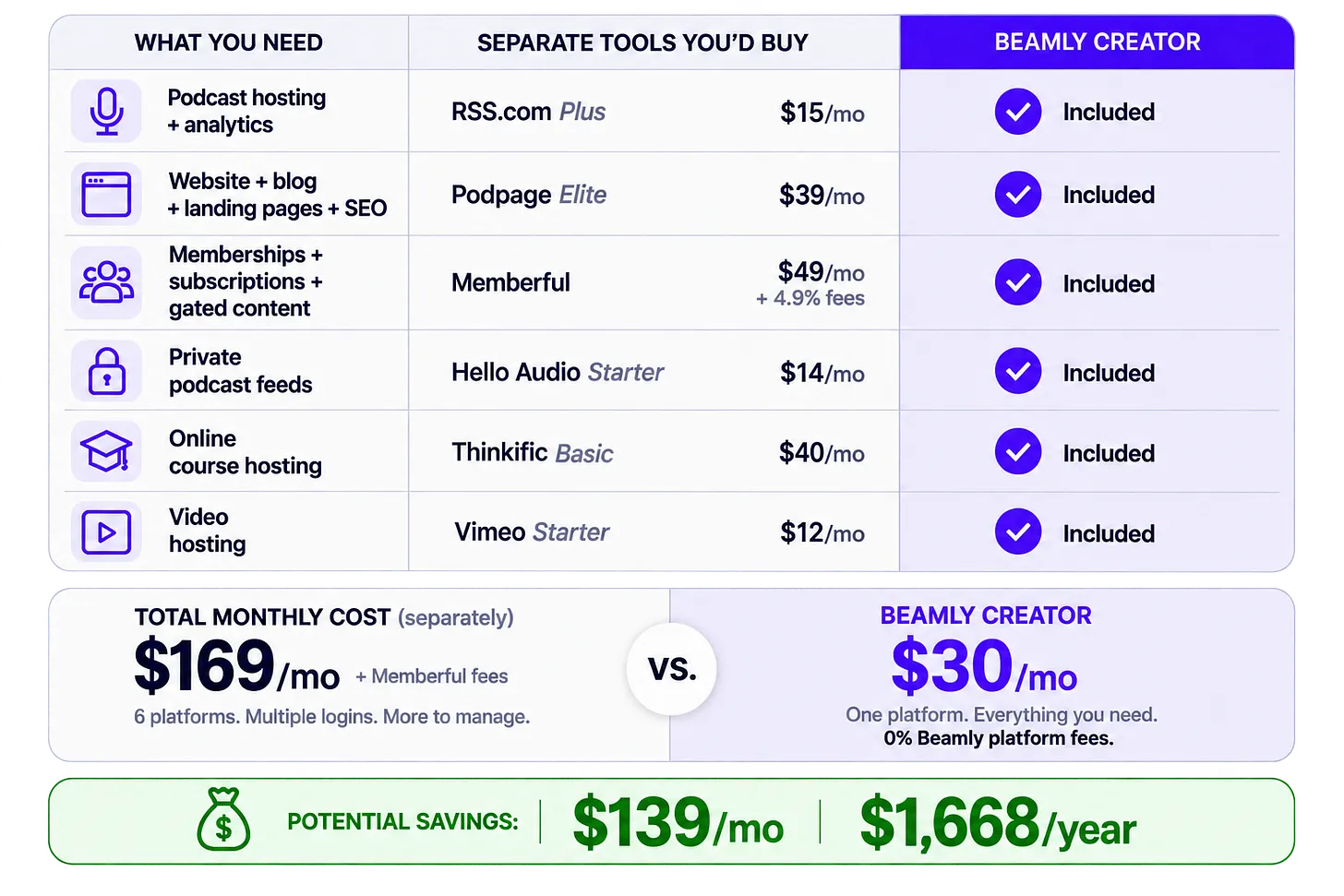
And that’s before the economics of a paid audience come into play. Supercast, for example, charges $0.59 per subscriber per month. At 500 subscribers, that’s $295/month. Beamly Creator includes paid memberships and private podcast feeds with 0% platform fees for up to 1000 members.³
Does Beamly Take a Cut of Your Subscription Revenue?
Nope. Beamly charges for its plan rather than taking a percentage of your membership revenue. Standard payment processing fees still apply, so “0% platform fees” doesn’t mean accepting payments is free. When comparing Beamly pricing with other options, add up the plan cost, processing fees, and any tools you’ll still need. Then compare that total with what you pay today.
Now, this isn’t a perfect apples-to-apples comparison because no two platforms offer the exact same functionality. And you may not need everything in this table. But that’s exactly the point.
Maybe you can replace two tools. Maybe it’s five. Either way, those harmless-looking $15, $39, and $49 subscriptions add up fast. And every platform you eliminate also means one less login, workflow, integration, and potential point of failure to maintain.
That doesn’t mean I’d tell every podcaster to migrate. If your current stack is simple, affordable, works well together, and isn’t limiting what you’re trying to do, don’t create a problem you don’t have.
But if you’re about to start a podcast from scratch or wondering why it takes seven platforms to run one podcast, Beamly would be high on my list of platforms to evaluate.
One important caveat: Beamly consolidates much of the infrastructure around your podcast, but keep in mind you’ll still need recording/editing software and, if you want broadcasts or automated email sequences, a dedicated email marketing platform.
The point isn’t that Beamly is the only software you’ll ever need. It’s that a significant portion of the infrastructure podcasters often pay for separately can potentially live under one roof for $30/month.
Is Beamly Worth It for Your Podcast?
I’d start with what you could stop paying for. If you need a podcast website, paid memberships, and a way to sell digital products, there are several jobs Beamly could bring together under one roof and one login. If you only need somewhere to upload your audio, you may have less to gain. A longer feature list isn’t the deciding factor. The question is whether you’ll use enough of those features to reduce your costs or make running your show easier.
3 Steps to Audit Your Podcast Tech Stack
1. Find out what you’re actually paying
List every platform you pay for to create, publish, market, monetize, or measure your podcast. Then calculate the annual cost.
Not the $12 here and $39 there. The annual total.
Most podcasters I talk to have never done this. I revisit mine annually and track every recurring software expense on a dedicated Google Calendar. That way, I know exactly what it costs to run my show and what it needs to generate to become profitable.
2. Give every tool a job
Next, look at each platform and ask: What job am I paying this tool to do?
Then look for three things:
Overlap: Am I already paying another platform to do this?
Necessity: Do I use it enough to justify the cost?
Specialization: Do I need the advanced functionality this tool provides?
This is where you may discover you’ve built a Frankenstack. There’s hope for you.
3. Pretend your existing stack doesn’t exist
Ask yourself: If I were building the simplest tech stack capable of running the podcast business I have today, what would I choose?
Then compare that answer to what you’re paying for today. If a platform like Beamly can do the jobs you need while eliminating multiple subscriptions and integrations, that’s when I’d seriously consider consolidation.
And if your podcast is at the epicenter of your business, Beamly is one platform I’d put to the test.
Explore Beamly →
Your tech stack should make it easier to run your podcast, not become another part of the podcast you have to manage. The goal isn’t to have the fewest tools. It’s to make sure every tool you’re paying for has earned its place.
1. Alex Sanfilippo, “Podcasting Tech Stack,” PodcastingStack.com, accessed September 3, 2026, podcastingstack.com
2. Beamly, accessed September 3, 2026, beamly.com
3. Beamly, “Pricing,” accessed September 3, 2026, beamly.com/pricing
Images by OpenAI
Beamly is an educational partner of PodLaunch. Before recommending any platform, we test it firsthand to understand what it does well, where its limitations are, and who we believe it’s best suited for.
